Expectations are now a two-way street
Demands on carriers in uShip’s In-Home Delivery program continue to rise. Now clients are being held accountable for accessorial fees. uShip’s Elevation Program formalizes standards for both clients and carriers.
Part I: Shipment Score
A new Shipment Score measures carrier performance against our client’s expectations.
Shipment Score is averaged over a rolling 90-day period. Based on 14-day pickup/30-day delivery standard.
The target shipment score is 80.
Note: Shipment Score replaces Chairish Carrier Score, where applicable, but does NOT replace or impact your Feedback score.
Shipment Score Summary:
Metric / % of Score
On-time Pickup: 40%
On-time Delivery: 40%
Late Pickup w/Update: 20%*
Late Delivery w/Update: 20%*
eBOL Use: 20%
*Late Shipments that receive a timely timeframe update that is adhered to earn 50% credit toward On-Time scoring

Shipment Score example:
| Carrier makes on-time pickup | +40 pts |
|---|---|
| Delivery late by 4 days | +00 pts |
| Timely timeframe update made in app, delivery made | +20 pts |
| eBOL is used for the shipment | +20 pts |
| Shipment Score | 80 points |
Shipment Score example:
| Carrier makes on-time pickup | +40 pts |
|---|---|
| Delivery late by 4 days | +00 pts |
| Timely timeframe update made in app, delivery made | +20 pts |
| eBOL is used for the shipment | +20 pts |
| Shipment Score | 80 points |
Part II: Service Level Agreement
uShip’s Elevation Program formalizes client fees and carrier fines when expectations are unmet.
Both shipping partners and transporters are being asked to sign an agreement that holds each party accountable.
To submit a client accessorial fee request, click here.
To submit a carrier fine request, click here.
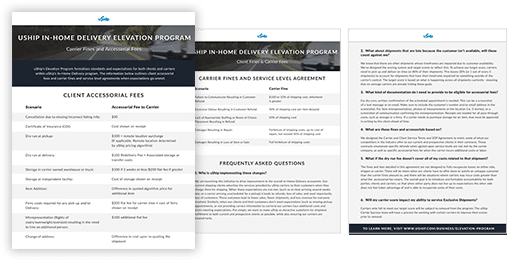
Useful Links
Elevation Program Frequently Asked Questions
Why is uShip implementing these changes?
We are launching this initiative to drive improvement to the overall In-Home Delivery ecosystem. Our current shipping clients advertise the services provided by uShip carriers to their customers when they charge them for shipping. When these expectations are not met, (such as an item arriving several weeks late, or a carrier arriving unscheduled for a pickup) it leads to refunds, loss of sales, and most importantly loss of customers. These outcomes lead to fewer sales, fewer shipments, and less revenue for everyone involved. Similarly, when our clients and their customers don’t meet expectations (such as missing pickup appointments, or not providing correct information to carriers) our carriers face additional costs and strain meeting expectations. Put simply, we want to make uShip as attractive a platform for shipment fulfillment to both current and prospective clients as possible, while also ensuring our carriers are treated fairly.
What about shipments that are late because the customer isn’t available, will these count against me?
We know that there are often shipments whose timeframes are impacted due to customer availability. We’ve designed the scoring system and target scores to reflect this. To achieve our target score, carriers need to pick up and deliver on-time on 80% of their shipments. These leaves 20% (or 1 out of every 5 shipments) to account for shipments that have their timeframe impacted by something outside of the carrier’s control. The target score is based on what is happening across all shipments currently – meaning that on average carriers are already hitting these goals.
What kind of documentation do I need to provide to be eligible for accessorial fees?
For dry runs, written confirmation of the scheduled appointment is needed. This can be a screenshot of a text message or an email. Make sure to include the customer’s number and/or email address in the screenshot. For item misrepresentation, photos of measurements or the location (i.e. 3 stories), or a screenshot of communication confirming the misrepresentation. Receipts are needed for all pass-through costs, such as storage or a ferry. If a carrier needs to purchase storage for an item, that must be approved in writing by the client ahead of time.
What are these fines and accessorials based on?
We designed the Carrier and Client Service Terms and SOP Agreement to mimic some of what our competitors in the industry offer to our current and prospective clients in their contracts. Those contracts enumerate specific refunds when agreed upon service levels are not met by the carrier company, as well as specific accessorial fees for when the carrier incurs additional costs or labor.
What if the dry run fee doesn’t cover all of my costs related to that shipment?
The fines and fees detailed in this agreement are not designed to fully recuperate losses on either side, shipper or carrier. There will be times when our clients have to offer more to satisfy an unhappy customer than the carrier fines amount to, and there will be situations where carriers may incur costs greater than what the accessorial fee covers. The overall goal is to introduce and formalize accountability for both parties, clients and carriers, so that when either party does not live up to expectations the other side does not feel taken advantage of and is able to recuperate some of their costs.
Will my carrier score impact my ability to service Exclusive Shipments?
Carriers who fail to meet our target score will be subject to removal from the program. The uShip Carrier Success team will have a process for working with certain carriers to improve their scores prior to removal.